1874, 1885, 1923, 1906
Yes, this is why I study history (several other good reasons too, but this one above all): because by doing so I encounter people who I would never have encountered otherwise; and the simple fact of their existence, and my now knowing of it, considerably enhances and enriches my own life.
None of these happenstance encounters are alive today, or if they are it is highly unlikely that I will ever meet them in person; many of them were not even alive recently, so there is no other way I might have come across them but through these adventures into art and literature and politics and sport and... Yet there are hundreds of them, even beyond the hundreds in this blog: the celebrated and famous in particular, but also, and somehow these matter to me so much more, the hordes of the forgotten, the shades of the overlooked, the great unplaid, the ghosts who haunt oblivion.
Who (out of the 6.5 billion people currently inhabiting the planet, I mean, not the handful here and there whose domain this happens to be) who has ever heard, for example, of
Amy Lawrence Lowell, born today in 1874
or
Alban Maria Johannes Berg, born today in 1885 (see April 1 for more on him)
or
Brendan Francis Aidan Behan, born today in 1923
or
P.L (Paul Laurence) Dunbar, who died today in 1906, even more anonymously to most of the world than Amy Lowell.
But let us try to make them better known:
Obviously that handful of you, Americans especially, who read poetry, will have come across that Boston Brahmin Robert Lowell (click here for my piece on his magnificent poem about the Quaker Graveyard in Nantucket; several others by or about him elsewhere in my "Private Collection", and he also makes appearances in this blog on Oct 13, Nov 9, Dec 6 but especially Nov 17). But Amy, his distant cousin, likewise a poet - an Imagist in her case - and wasn't there another famous relative, a scientist perhaps, named Percival, and another who was a politician, and a President of Harvard, and a third poet too, great uncle James Russel Lowell? Great family, the Winslow-Lowells. For a full biography of Amy, and a selection of her poetry, click here.Lovers of 20th century experimental music will know the name Alban Berg, but that's probably less than two hundred people world-wide (and two-thirds of them are reconsidering), and I'll bet there aren't four among them who could actually name a piece he wrote (you can cheat by clicking here), or even say they've ever heard one (me included). He was one of the disciples of Gustav Mahler who listened to those extraordinary symphonies and recognised that they, along with the works of Debussy and Ravel, to some degree of Wagner, had brought European music to the summit of the wave, from where there was nowhere else to go except watching it crash (Glass, Reich, Nyman...), or inventing something new and different with which to turn the tide. Like that other Mahler disciple Arnold Schönberg, he tried the side-street of atonal music, but quickly discovered that it was a cul-de-sac, and he, personally, at the wrong end of a no-through-road. Worth listening to, though. Try here.
As to Brendan Behan - wonderful playwright, even better poet and short story writer, and significant to me above all else because, like R.S Thomas in Welsh, he used both the English that had been imposed on his people and was therefore unavoidable, but also his native Celtic, or Gaelic, or Goedelic - so many names for the language now, but so very few people who can speak it, let alone write poetry in it.
Which leaves us with P.L. Dunbar.
In the early years of the century I wrote a novel that was intended to be a satire, except that the inner themes driven by the characters I discovered forced it to turn serious. "A Journey In Time" explored the universal history of one day, my birthday, June 27th, with the firm resolve to research and write about, and no exceptions, no personal preferences and leavings-out, people who were born, or died, events that happened, on that particular date. So I found several characters who now also appear in this blog, such as Prudence
Crandall (see Jan 28), and wrote this about the previously unknown-to-me Paul Laurence Dunbar...
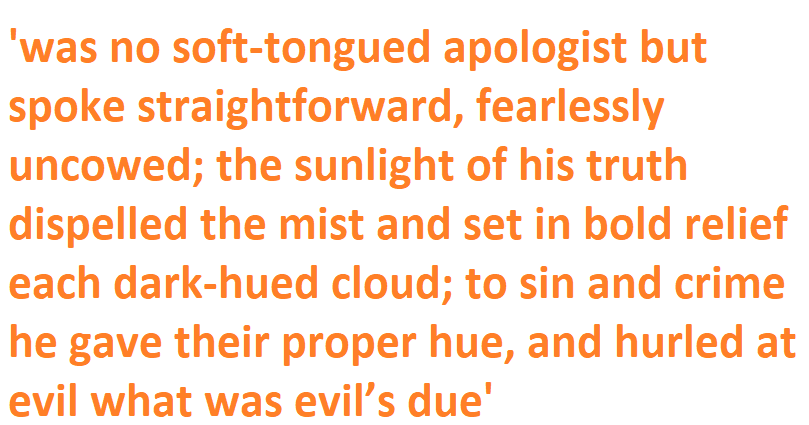
"...the voice of Liberty Bell and the Smithsonian, a man who might himself have been a student at Prudence Crandall’s academy, though in fact he was born too late for that, on June 27th 1872 to be precise, and he would grow up to become the first of that most implausible of beings: a black American poet of genuine regard, one who, as he wrote of Frederick Douglass*, one of the foremost leaders of the abolitionist movement, the principal black speaker for the American Anti-Slavery Society and later adviser to President Lincoln during the Civil War,

"His reputation resting upon verse and short stories written largely in black dialect – incomprehensible dialect to those of us who get our 'negro' understanding from 'Porgy and Bess'; but for all their incomprehensibility, the passion of their politics comes through, with far more power than his tame love lyrics written in the mode of the Romantics - he was the first black writer in the U.S. to make a concerted attempt to live by his writings, and one of the first to attain national prominence...
"Dunbar’s parents were former slaves; his mother had been freed, his father had escaped to freedom in Canada and then returned to the U.S. to fight in the Civil War. Paul was the only black student in his Dayton high school, where he edited the school paper. He published his first volume of poetry, 'Oak and Ivy', in 1893, at his own expense while working as an elevator operator, and sold copies to his passengers to pay for the printing. His second volume, 'Majors and Minors', in 1895, attracted the favourable notice of the novelist and critic William Dean Howells, who also introduced Dunbar’s next book, 'Lyrics of Lowly Life', in 1896, which contained some of the finest verses of the first two volumes.
Folks ain’t got no right to censuah othah
folks about dey habits;
Him dat giv’ de squir’ls de bushtails made de
bobtails fu’ de rabbits.
Him dat built de gread big mountains hollered
out de little valleys,
Him dat made de streets an’ driveways wasn’t
shamed to make de alleys.
"In the 1890s, amongst certain middle class persons in white America, Dunbar’s poems were in vogue. He read them aloud to audiences across the U.S.A, and even came to England to recite them, equally in elegant salons and dusty public libraries, and when he returned from abroad he was given a job in the reading room of the Library of Congress in Washington D.C, where blacks were not normally permitted, except as janitors. He turned to fiction as well as verse, writing for a predominantly white readership, publishing four collections of short stories and four novels before his early death, making use of the then current plantation tradition, depicting the pre-Civil War South in pastoral, idyllic tones. Only in a few of his later stories did a suggestion of racial disquiet appear.
"His first three novels - including 'The Uncalled', published in 1898, which reflected his own spiritual problems - were about whites. His last and best came out in 1902; 'The Sport of the Gods' told of an uprooted black family in the urban North. But it is his poetry that has survived him, a black Rudyard Kipling or Negro Robert Service.
Dey’s a so’t o’ threatenin’ feelin’ in de blowin’ of de breeze,
An’ I’s feelin’ kin’ o’ squeamish in de night;
I’s a-walkin’ ’roun’ a-lookin’ at de diffunt style o’ trees,
An’ a-measurin’ dey thickness an’ dey height.
Fu’ dey’s somep’n mighty ’spicious in de looks de da’kies give,
Ez dey pass me an’ my fambly on de’ groun’,
So it ’curs to me dat lakly, ef I caihs to try an’ live,
It concehns me fu’ to ’mence to look erroun’.
Dey’s a cu’ious kin’ o’ shivah runnin’ up an’ down my back,
An’ I feel my feddahs rufflin’ all de day,
An’ my laigs commence to trimble evah blessid step I mek;
W’en I sees a ax, I tu’ns my head away.
Folks is go’gin’ me wid goodies, an’ dey’s treatin’ me wid caih,
A’ I’s fat in spite of all dat I kin do.
I’s mistrus’ful of de kin’ness dat’s erroun’ me evahwhaih,
Fu’ it’s jes’ too good, an’ frequent, to be true.
Snow’s a-fallin’ on de medders, all erroun’ me now is white,
But I’s still kep’ on a-roostin’ on de fence;
Isham comes an’ feels my breas’bone,
     an’ he hefted me las’ night,
An’ he’s gone erroun’ a-grinnin’ evah sence.
’T ain’t de snow dat meks me shivah;
     ’t ain’t de col’ dat meks me shake;
’T ain’t de wintah-time itse’f dat’s ’fectin me;
But I t’ink de time is comin’, an’ I’d bettah mek a break,
Fu’ to set wid Mistah Possum in his tree.
W’en you hyeah de da’kies singin’, an’ de quahtahs all is gay,
’T ain’t de time fu’ birds lak me to be erroun’;
W’en de hick’ry chips is flyin’, an’ de log’s been ca’ied erway,
Den hit’s dang’ous to be roostin’ nigh de groun’.
Grin on, Isham!  Sing on, da’kies! But I flop my wings an’ go
Fu’ de sheltah of de ve’y highest tree,
Fu’ dey’s too much close ertention –
     an’ dey’s too much fallin’ snow -
An’ it’s too nigh Chris’mus mo’nin’ now fu’ me.
* More on Frederick
Douglass on Feb 14 and Aug 11
You
can find David Prashker at:
Copyright
© 2018/2024 David Prashker
All
rights reserved
The
Argaman Press